Michael entered a monastery near the Black Sea under the guidance of Patriarch Tarasius. Theophylact, later Bishop of Nicomedia, was his fellow monk. Michael subsequently became Bishop of Synnada and participated in the Council of Nicaea associated with the restoration of icon veneration. When Leo V renewed the imperial campaign against icons, Michael refused to remove them from the churches. He explained that the honor shown to the images belonged to Christ, the Theotokos, and the saints represented. Exile followed his refusal. The Church remembers his episcopal teaching and clear confession under pressure.
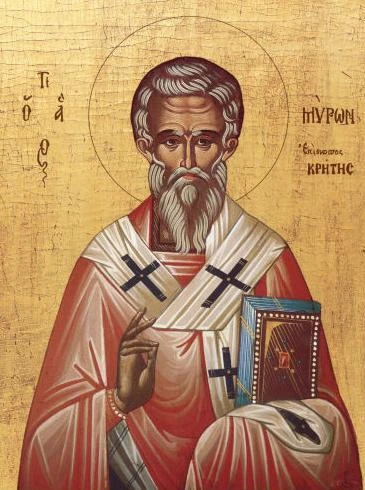
Myron came from Avrachi in Crete and worked the land. The received life tells how he encountered thieves filling sacks from his grain and helped them lift the sacks instead of retaliating. He later became a priest and bishop of Crete, serving into old age.
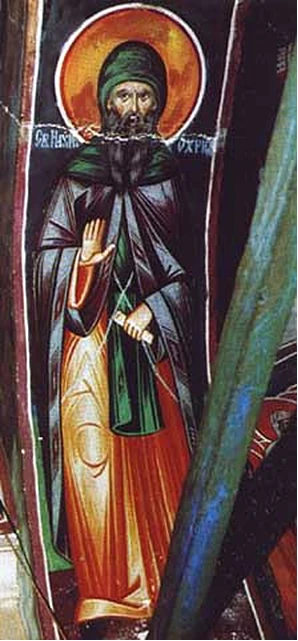
Naum followed Cyril and Methodius in their work in Moravia and Rome. The Bulgarian Church’s received life remembers his ordination as a priest in Rome and his arrival in Bulgaria with Clement after Methodius died. He remained at Pliska before taking up teaching work when Clement became a bishop. He later established a monastery dedicated to the Holy Archangels beside Lake Ohrid. He died in 910 and was buried at the monastery.
Naum followed Cyril and Methodius in their work in Moravia and Rome. The Bulgarian Church’s received life remembers his ordination as a priest in Rome and his arrival in Bulgaria with Clement after Methodius died. He remained at Pliska before taking up teaching work when Clement became a bishop. He later established a monastery dedicated to the Holy Archangels beside Lake Ohrid. He died in 910 and was buried at the monastery.
Nicholas served as bishop of Myra in Lycia. The Church remembers his generous care for people in need and his defense of those facing injustice. His traditional life brings together public responsibility and quiet acts of mercy.
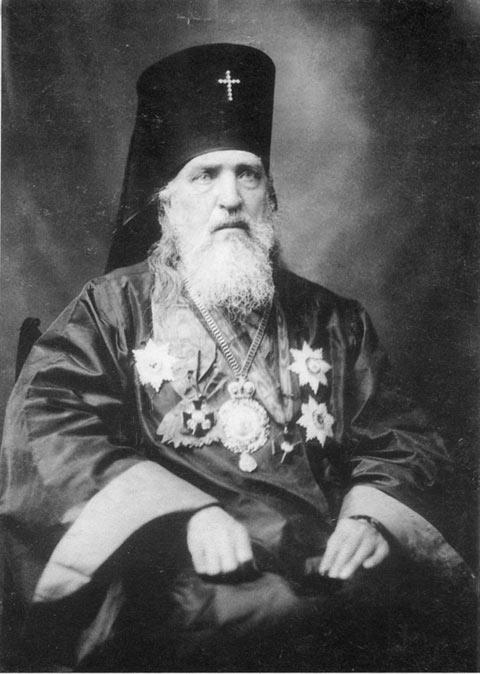
Nicholas Kasatkin arrived in Hakodate as a young priest and devoted his early years to learning Japanese language, culture, and daily life. His later ministry translated Scripture and church books, trained clergy, and established schools and other institutions. A growing Japanese Orthodox community developed around that sustained work. During the Russo-Japanese War he remained with his flock while arranging spiritual help for Russian prisoners. He eventually served as Archbishop of Tokyo and All Japan. His life shows how missionary responsibility depends on patient preparation, intelligible teaching, and care for people across national divisions.
The directory indexes the OCA full-year calendar, including leap-day commemorations, alongside additional researched profiles. Calendar entries include individual saints, groups, icons and feasts. An entry count is not a count of unique saints. Categories are provisional; follow the linked source.
Dates show commemorations in the referenced calendar year. Movable feasts change annually, and local calendars may differ. Additional jurisdictions, original biographies and icon research remain in progress. This collection does not yet claim complete Eastern Orthodox coverage.
Calendar metadata was retrieved through Orthocal’s source repository and the Orthodox Church in America. Source-only calendar records link to their original accounts; researched profiles include individually sourced artwork.
 Patron SaintTake the quiz