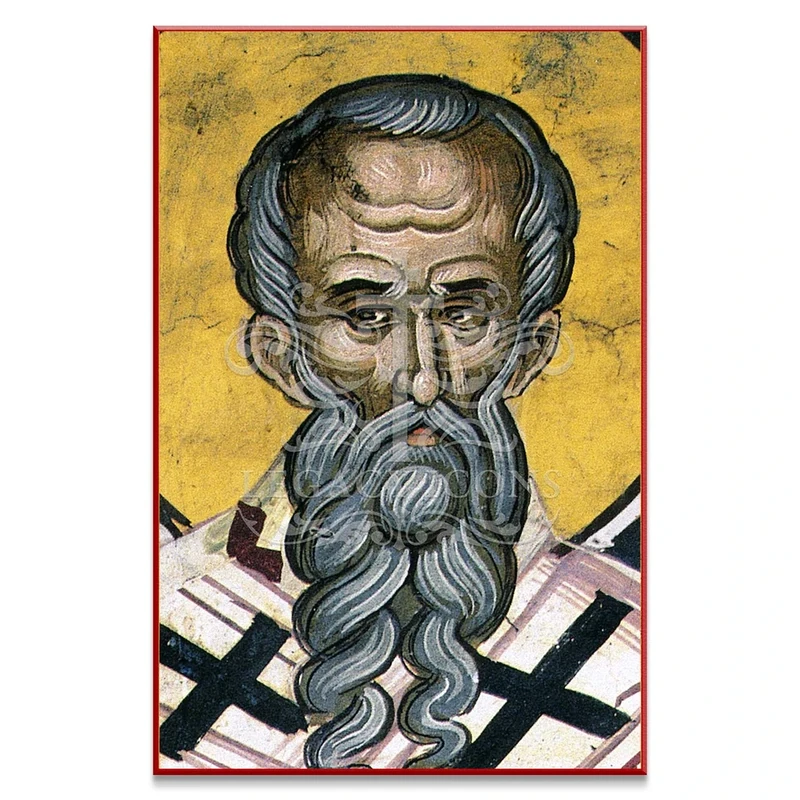
Eusebius served as Bishop of Samosata during the fourth-century disputes over the Nicene confession of faith. He resisted imperial pressure, endured exile, and traveled to support Christian communities that lacked clergy. The Orthodox account remembers him helping appoint bishops, priests, and deacons while encouraging congregations to remain steadfast. When ordered into exile, he left quietly to reduce the risk of public unrest. After returning, he continued his work until an attacker struck him with a roof tile. As he lay dying, he asked those nearby not to harm the woman responsible. His witness joins doctrinal courage to restraint and forgiveness.
Euthymius served as Bishop of Sardis and participated in the Council of Nicaea in 787, where he opposed iconoclasm. The OCA's life remembers repeated pressure on him to abandon the veneration of icons. Removal, exile, and physical punishment did not bring the demanded change in his confession. He eventually died after severe mistreatment under Emperor Theophilus. His commemoration belongs to the Church's memory of bishops who suffered during the iconoclast controversy. The source's compressed sequence of rulers and places requires further historical comparison; his participation in the council and steadfast confession provide the central outline of this profile.
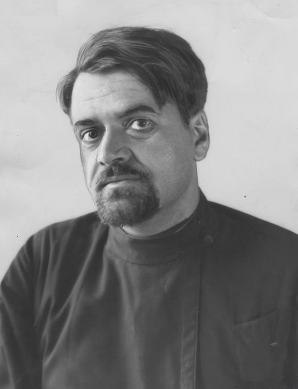
Gregory Peradze studied theology, languages, and Georgian monastic history before becoming a monk and priest. He served a Georgian parish in Paris and taught in Warsaw, while searching libraries and monasteries for neglected manuscripts. His work preserved important witnesses to Georgian Christian culture. During Nazi persecution he aided Jewish people and others in danger. Arrested in 1942, he was imprisoned and deported to Auschwitz, where he died. The Church remembers scholarly discipline joined to humility and costly care for neighbors. His life shows learning becoming both the preservation of memory and a responsibility toward living people.
Gregory’s traditional life begins with exile from Armenia and his conversion to Christianity in Cappadocia. He later served Tiridates, whose anger at Gregory’s faith brought imprisonment and suffering. After his release, Gregory cared for the memory of Christian martyrs and preached to the people. The account associates him with the conversion of the king and the establishment of churches, schools, monasteries, and ordained ministry throughout Armenia. He eventually withdrew into the wilderness. Orthodox commemoration honors his perseverance and the work of building a Christian community after persecution, linking personal witness with enduring institutions of teaching and worship.
Hermogenes served as a priest in Kazan before becoming a monk, metropolitan, and eventually Patriarch of Moscow. His earlier ministry included several days of instruction for newly baptized Tatars and writing accounts of local saints and the Kazan icon. As patriarch during the Time of Troubles, he addressed letters to communities divided by political conflict, urging fidelity and an end to bloodshed. His resistance to the forces occupying Moscow led to imprisonment. He continued sending messages from confinement and died of starvation in 1612. His commemoration remembers pastoral teaching and steadfastness while requiring care about the national and political language surrounding his life.
Hermogenes served as a priest in Kazan before becoming a monk, metropolitan, and eventually Patriarch of Moscow. His earlier ministry included several days of instruction for newly baptized Tatars and writing accounts of local saints and the Kazan icon. As patriarch during the Time of Troubles, he addressed letters to communities divided by political conflict, urging fidelity and an end to bloodshed. His resistance to the forces occupying Moscow led to imprisonment. He continued sending messages from confinement and died of starvation in 1612. His commemoration remembers pastoral teaching and steadfastness while requiring care about the national and political language surrounding his life.
The directory indexes the OCA full-year calendar, including leap-day commemorations, alongside additional researched profiles. Calendar entries include individual saints, groups, icons and feasts. An entry count is not a count of unique saints. Categories are provisional; follow the linked Orthodox source.
Dates show commemorations in the referenced calendar year. Movable feasts change annually, and local calendars may differ. Additional jurisdictions, original biographies and icon research remain in progress. This collection does not yet claim complete Eastern Orthodox coverage.
Calendar metadata was retrieved through Orthocal’s source repository and the Orthodox Church in America. Source-only calendar records link to their original accounts; researched profiles include individually sourced artwork.
 Patron SaintTake the quiz