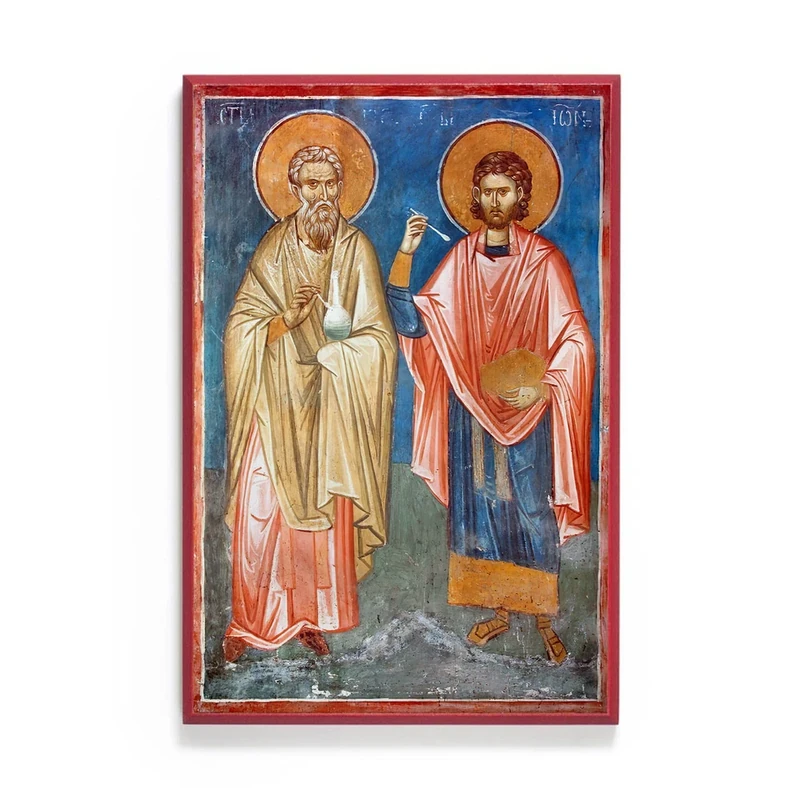
Cyrus practiced medicine in Alexandria and offered care without payment. His traditional life remembers Christian teaching alongside concern for sick people. During persecution he withdrew to Arabia and became a monk. John later joined him as a companion. Hearing that Athanasia and her daughters had been imprisoned, Cyrus and John went to encourage them. Their visit led to their own arrest and martyrdom. The Church remembers Cyrus as a healer whose compassion extended beyond the treatment room to people facing coercion, imprisonment, and fear.
John was a Christian soldier from Edessa. During persecution he traveled to Jerusalem, heard about the physician Cyrus, and sought him through Alexandria into Arabia. Finding Cyrus, he remained as his companion. Together they visited the imprisoned Athanasia and her daughters to strengthen them in faith. That act of encouragement brought their own arrest, and they suffered martyrdom with the women. John is honored with Cyrus among the unmercenaries. His story remembers companionship that became service and courage directed toward people who were isolated and afraid.
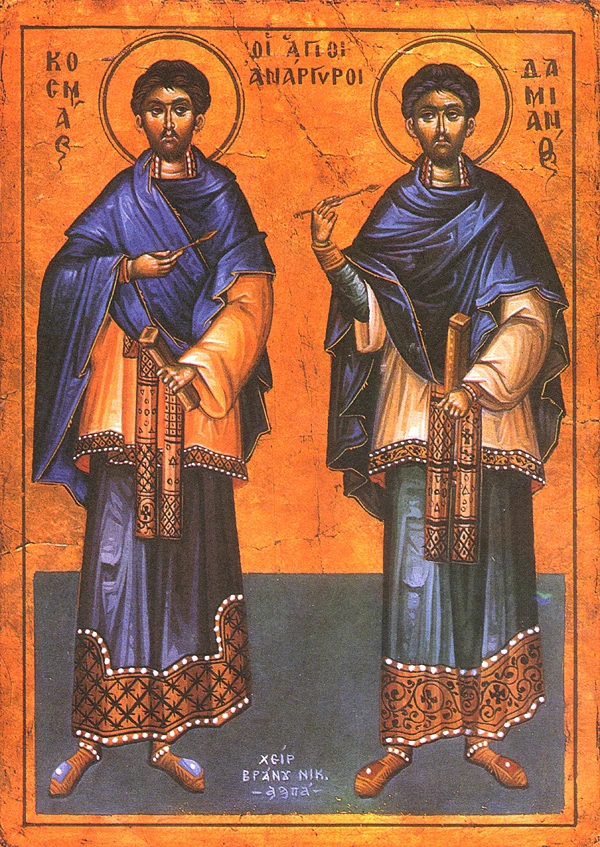
Cosmas and his brother Damian were raised in Christian faith by their mother Theodota. They trained as physicians and offered treatment without charge, caring for people and even animals. Their traditional life remembers prayer as central to that service. Cosmas’s concern to preserve their commitment to free care appears in a story about a grateful patient’s gift to Damian. The Church honors the brothers together, remembering compassion that did not depend on a patient’s ability to pay and a household whose faith developed into practical service.
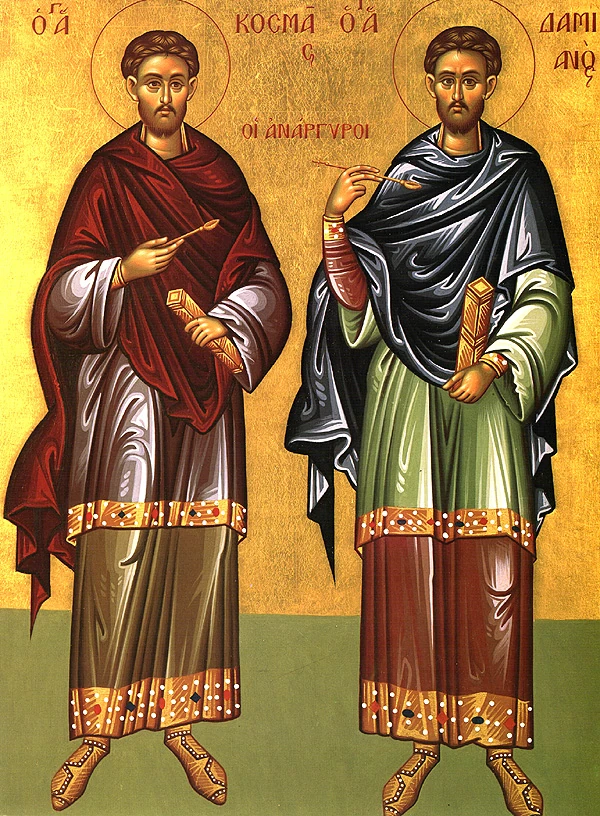
Damian shared medical service with his brother Cosmas after their mother Theodota raised them in Christian devotion. They treated sick people freely and extended their care to animals. The traditional account singles out Damian accepting a small gift when a healed woman offered it in the name of the Trinity. The story distinguishes that gesture from taking payment for healing. Damian and Cosmas were eventually buried together. Their shared commemoration remembers generosity, gratitude, and the challenge of preserving a sincere purpose without judging another person too quickly.
Cosmas and his brother Damian were physicians in Rome who offered treatment without payment. Their kindness and Christian witness drew people to the Church and brought official scrutiny. When soldiers arrested neighbors in their place, the brothers surrendered and asked that those prisoners be released. The traditional life remembers their confession before the emperor and their eventual return to medical care. They later died through the violence of an envious teacher. Cosmas is honored with Damian as a martyr whose healing work was joined to responsibility for endangered neighbors.
Damian practiced medicine with his brother Cosmas, freely helping sick people in Rome. The brothers understood their abilities as a gift to be shared rather than a means of collecting payment. Their traditional life describes their willingness to face arrest when other Christians were detained because officials could not find them. After a trial, they resumed their work. A former medical teacher later killed them while they gathered herbs. The Church remembers Damian with Cosmas, preserving the connection between generous professional service, shared faith, and concern for others.
The directory indexes the OCA full-year calendar, including leap-day commemorations, alongside additional researched profiles. Calendar entries include individual saints, groups, icons and feasts. An entry count is not a count of unique saints. Categories are provisional; follow the linked source.
Dates show commemorations in the referenced calendar year. Movable feasts change annually, and local calendars may differ. Additional jurisdictions, original biographies and icon research remain in progress. This collection does not yet claim complete Eastern Orthodox coverage.
Calendar metadata was retrieved through Orthocal’s source repository and the Orthodox Church in America. Source-only calendar records link to their original accounts; researched profiles include individually sourced artwork.
 Patron SaintTake the quiz