Gabriel used an inheritance from his parents to establish monastic life at Lesnovo near Kratovo. He built a church dedicated to the Archangel Michael, and a community of monks gathered around him. After appointing an abbot and placing his resources at the monastery's service, he withdrew into solitude. The Orthodox account remembers a long period of prayer and fasting in a secluded place before his return to the community. He died peacefully, and his relics later became a focus of devotion. His life connects generosity with a desire for prayer, allowing a shared foundation to continue under another person's leadership.
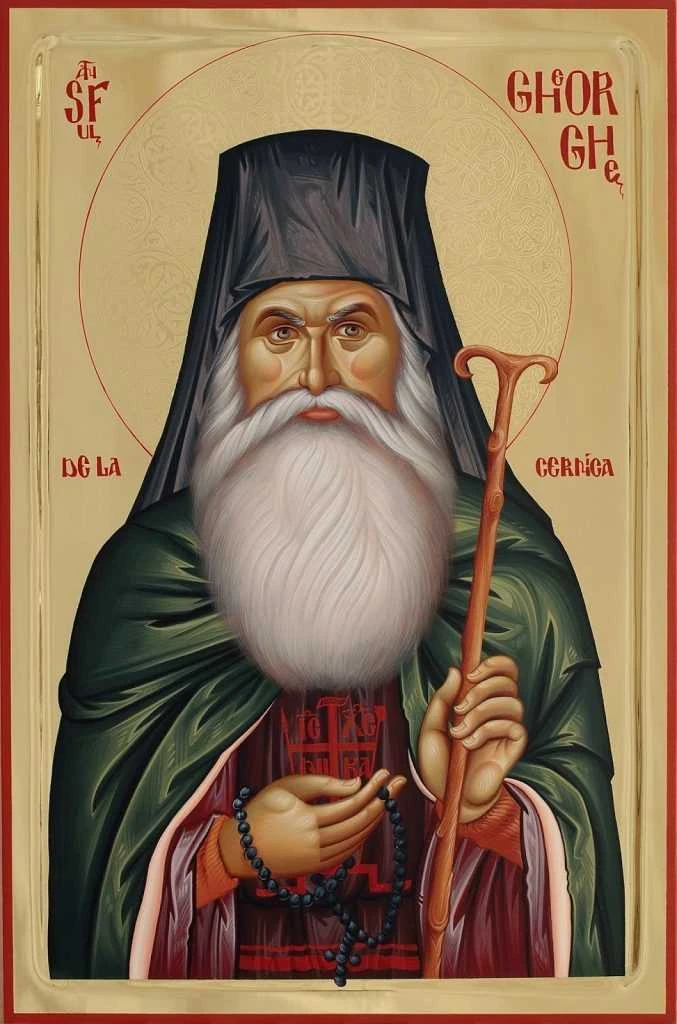
George, known in Romanian as Gheorghe, came from the region of Sibiu. His monastic formation took him to Mount Athos, where he joined Paisius Velichkovsky in prayer, reading, and translating religious books. He later accepted responsibility for restoring communal monastic life at Cernica. The official life describes him clearing the overgrown site himself before a larger community formed around him. His responsibilities eventually extended to Căldărușani. George guided the monks toward mutual love, humility, and stability in their vocation. He died in 1806.
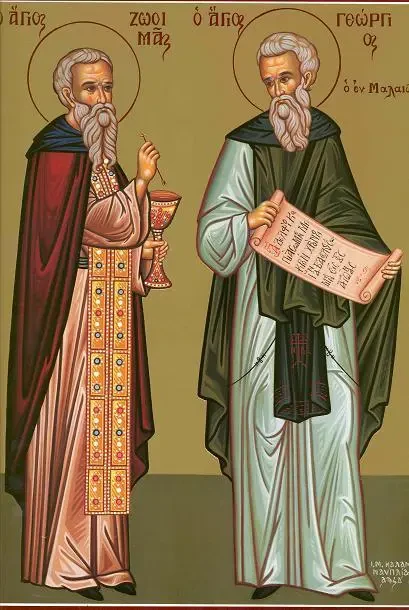
George lived in the ninth century. When his parents wished him to marry, he chose monastic life and entered a monastery on Mount Maleon in the Peloponnese. Many disciples gathered around him. The received account also remembers him as having foresight and foretelling his death three years before it occurred.
George came from Cyprus and entered monastic life in the Holy Land. He learned prayer and obedience at Choziba and later lived beside his brother at another monastery near the Jordan. After his brother’s death, he returned to Choziba. War forced him away for a time, but he returned again when circumstances allowed. The monastery preserves his remembrance alongside later saints connected with the same place.
Gerasimus came from Lycia and pursued monastic life in Egypt before settling near the Jordan. He founded a community whose rhythm combined days of solitude and handwork with shared worship and Communion at the weekend. The received life remembers cells left open for someone who needed rest or supplies. It also acknowledges that Gerasimus accepted correction from Euthymius during a theological controversy. His disciples included Cyriacus. A famous story about a lion that aided him explains the animal often shown in his icons. His commemoration joins disciplined prayer with hospitality and the humility to learn again.
Gerasimus received monastic formation in Kyiv and accepted priestly ordination before traveling north to the Vologda River. The OCA's received life remembers him establishing a solitary dwelling across a creek from the developing settlement. Prayer and work shaped that life, which eventually included the construction of a Trinity church and the beginning of a monastery. His commemoration connects the search for solitude with a foundation that served the surrounding population. Prophecies about the future city and the exact early chronology remain elements of the received narrative rather than independently established conclusions.
The directory indexes the OCA full-year calendar, including leap-day commemorations, alongside additional researched profiles. Calendar entries include individual saints, groups, icons and feasts. An entry count is not a count of unique saints. Categories are provisional; follow the linked source.
Dates show commemorations in the referenced calendar year. Movable feasts change annually, and local calendars may differ. Additional jurisdictions, original biographies and icon research remain in progress. This collection does not yet claim complete Eastern Orthodox coverage.
Calendar metadata was retrieved through Orthocal’s source repository and the Orthodox Church in America. Source-only calendar records link to their original accounts; researched profiles include individually sourced artwork.
 Patron SaintTake the quiz